.svg)
Streamlining NHS Sustainability Compliance: The Nocomed Advantage for Life Science Suppliers
For life science companies supplying the NHS, sustainability compliance is now a familiar requirement. Procurement Policy Note (PPN) 006, formerly PPN 06/21, mandates that life sciences suppliers bidding on new NHS contracts and those supplying the NHS create an annual carbon reduction report.
The journey towards NHS PPN 006 sustainability compliance requires 4 core steps for your team, from establishing a factual baseline, to setting an informed net-zero target for your organisation, to implementing carbon reduction measures, and finally annual publication of emissions date.

The two main outcomes are
- information to enable completion of the NHS Evergreen Sustainable Supplier Assessment
- publication on your website of an NHS-compliant Carbon Reduction Plan
1. Establishing a Factual Carbon Footprint Baseline
The foundational requirement of PPN 006 is for NHS suppliers to understand, we could call it 'scope', their environmental impact through logging of greenhouse gas (GHG) emissions in keeping with the GHG Protocol.
This "baseline" serves as the reference point against which all future carbon emissions reductions are measured. Life science suppliers must report on Scope 1 (direct) and Scope 2 (indirect energy) emissions, alongside a specific subset of Scope 3 categories: business travel, employee commuting, waste generated in operations, and both upstream and downstream transportation and distribution.

Utilising a software platform like Nocomed transforms this often daunting data collection task into a streamlined, site wide or organisation wide process. It enables smooth management of evolving requirements as sustainability compliance in the healthcare space evolves. Two aspects merit specific mention.
- Firstly, different levels of Evergreen Supplier Assessment necessitate different organisational geographic boundaries that a life science suppliers must consider: Levels 3 and 4 requirement inclusion of global entities / sites.
- Secondly, the list of scope 3 categories increases in 2027.
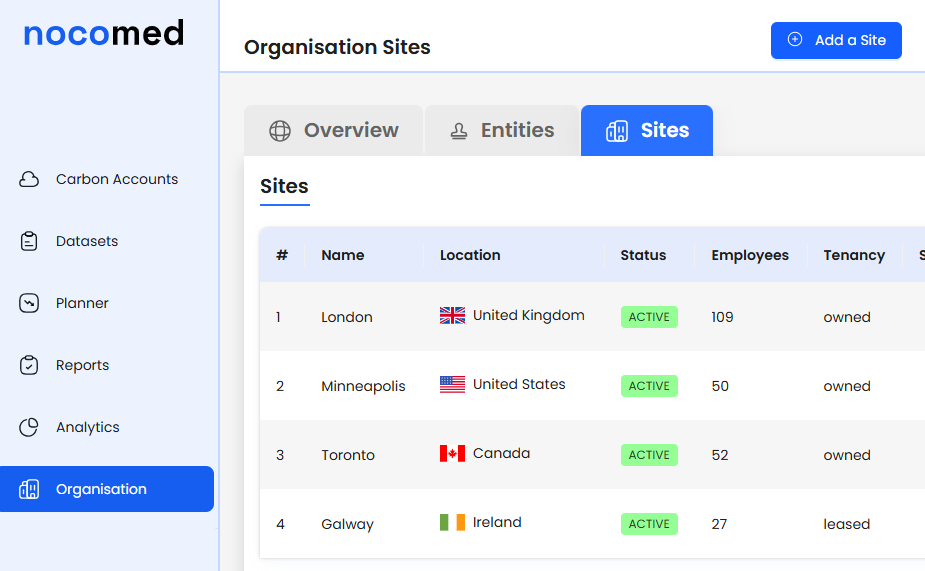
Rather than handling raw data year after year for a one-time report, Nocomed allows organisations to capture raw data from energy bills, monitor refrigerants, and track shipments and more with datasets designed for life science organisations. This approach ensures your organisation "owns" its data, creating transparent and, if necessary auditable, information. By housing this information in one site-wide platform, you build organisational sustainability knowledge, ensuring that the data is readily available for future years without the need to start from scratch. A common challenge that we here is working with disparate pdfs / spreadsheets each year. Nocomed addresses this problem and your team establishes a factual baseline with information in a single-system and available across the organisation.

2. Committing to a Net Zero Year
Once a factual baseline is established, your sustainability leads and leadership team can confidently choose an evidence-based Net Zero target year.
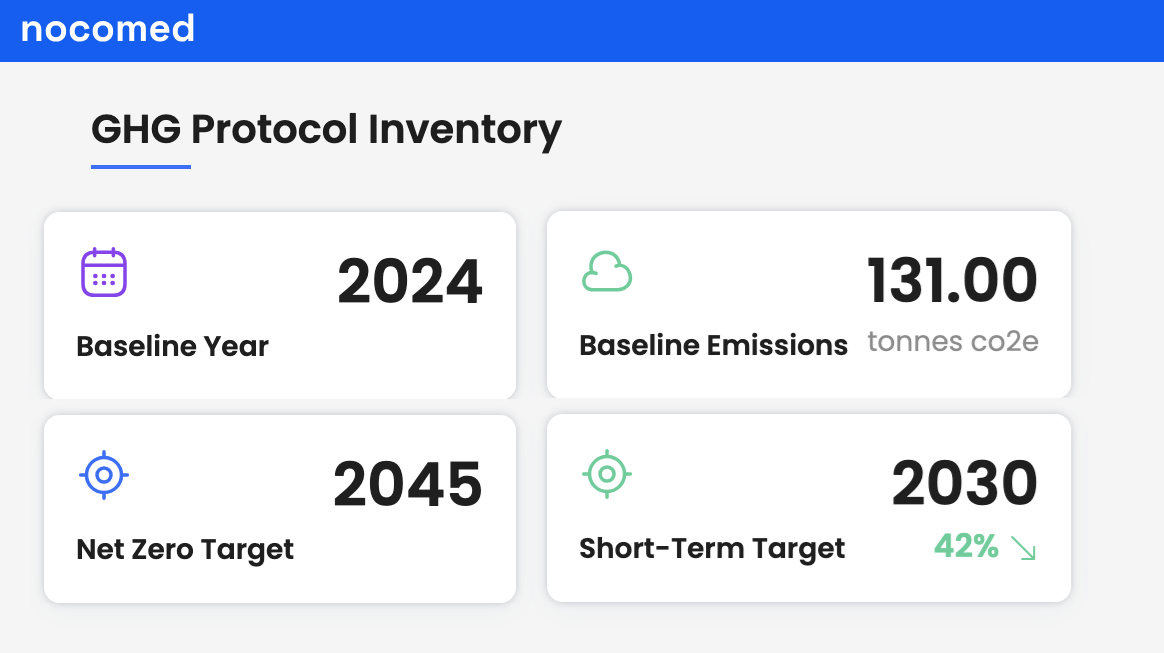
PPN 006 requires a signed declaration confirming your commitment to achieving Net Zero by 2050 (at the latest) for UK operations so this is a serious step. The NHS's own target net zero year is 2045 for direct (scope 1 and 2) emissions, with an ambition to reach an 80% reduction by 2036 to 2039. Many leading life science suppliers aim for earlier dates, such as 2030 or 2045, to align with NHS ambitions or global corporate strategies.

The value of a software tool in this phase is the ability to make data-driven commitment to a target net-zero year. Because Nocomed provides a clear, factual view of current emissions and insight into which aspects of the organisation are creating carbon emissions, leadership can set realistic, science-based targets grounded in knowledge of life science organisations rather than choosing arbitrary dates. Nocomed makes these commitments visible across the organisation, ensuring they translate into measurable action.
3. Implementing Reduction Targets and Environmental Measures
Next a NHS-compliant carbon reduction plan must detail your environmental management measures, the projects or activities you will undertake to work toward your net-zero target.
These might include initiatives like transitioning to 100% renewable energy, electrifying company fleets, or adopting sustainable packaging. Suppliers are also expected to provide carbon reduction targets, projecting how emissions will decrease over the next five years. Be inspired by our benchmark report on the carbon reduction plan of fellow NHS life science suppliers.

Nocomed provides the unique advantage of ongoing emissions management that no static pdf report can provide. While a report can offer an accurate single point in time, a software platform allows you to track progress against targets in real-time. This continuous visibility ensures that sustainability projects remain on track and that the "learning" from these initiatives is captured within your own team and organisation. This is vital as requirements, such as the required list of scope 3 categories, evolve while your carbon emissions GHG baseline and net-zero year are fixed. Further, seeing is believing and the visual nature of Nocomed enables teams to share information, make informed trade-offs, and collaborate to identify and implement carbon reduction project.
"Perhaps the most value aspect of working with Nocomed is the interactive real-time graphs and pie charts where we can easily see what's generating carbon and compare one aspect against others."
Nocomed customer.
4. Publishing According to the NHS Template
The final step in the compliance process is the formal publication of the carbon reduction plan.
To comply with the NHS Evergreen Supplier requirements, the carbon reduction plan must be published on your website, be signed off by a director (or equivalent) within the last 12 months, and strictly follow the required reporting standard and template.

The Nocomed platform further simplifies this final hurdle by automatically generating an NHS-compliant carbon reduction plan Suppliers can simply download the formatted document and publish it directly to their website as Nocomed customer Kora's Healthcare does, ensuring they stay aligned with current NHS guidance without manual rework.

This automated process reduces the risk of human errors, makes your sustainability efforts and status transparent to your team, and ensures that the organization’s sustainability efforts are presented in a way that is fully recognized and rewarded by NHS procurement teams.
To learn more about how Nocomed's sustainability platform can support emissions management for your lifesciences organisation, contact us at the link below.