
Lean with Green Lenses at UCD Mater 13th National Annual Healthcare Symposium
Lean with Green Lenses: Putting People and Planet at the Heart of Healthcare Improvement
The 13th Annual National Lean Healthcare Symposium in Dublin hosted by University College Dublin's Health Systems & the Mater Hospital's Lean Academy brings together people passionate about improving healthcare. The theme “Lean forward: putting people at the heart of improvement” is aligned with our mission here at Nocomed to advance sustainability across the healthcare supply chain. Rosemary Durcan, CEO, shows that improvement teams, already familiar with removing waste, can also cut healthcare's carbon footprint in "Lean with Green Lenses, Putting People and Planet at the Heart of Improvement".
Rosemary's message is simple: If you work in Lean, you already have skills applicable to healthcare sustainability. Just add one more lens to the way you look at waste: a green one.
Healthcare's Climate Contradiction
Everyone in healthcare works to make people healthier. Yet the sector produces about 4.4% of global net greenhouse gas emissions. If healthcare were a country, it would be the fifth largest emitter in the world (Health Care Without Harm and Arup, 2019).

This isn't about blame. The people best placed to change it are the people who run healthcare every day, and improvement teams are high on that list.
Climate Change Is Already In An Operational Threat To Our Hospitals
The health effects of climate change are not a future problem. Patients and staff across Europe are feeling them now.

Extreme Heat. An estimated 62,775 people died from heat in Europe in summer 2024 (Nature Medicine, 2025). Heat hits infrastructure too: when London reached 40°C in July 2022, both Guy's Hospital and St Thomas' Hospital data centres failed impacting IT systems across these hospitals. Staff went back to paper and operations were cancelled. (Guy's and St Thomas' NHS Foundation Trust, incident review, 2023).
Severe Flooding. The Valencia floods of October 2024 killed more than 220 people and damaged hospitals and health centres (European Commission, 2025). Intensive care units across the region admitted flood-related patients for a month afterwards. (Medicina Intensiva, 2026).

- Air Pollution. The European Environment Agency estimates there were around 222,000 premature deaths in the EU in 2024 from fine particulate matter. Heart disease and stroke are the most common causes, adding pressure on cardiac, stroke and respiratory departments in acute hospitals, as well as rehab and primary care services.

What We Buy Matters Most: Healthcare’s 71% Carbon Footprint

Around 71% of healthcare's emissions come from the supply chain: the medicines, devices, and other goods and services the sector buys (Health Care Without Harm and Arup, 2019). Pharmaceuticals account for an estimated 25–35% of healthcare emissions and medical technologies for 15–25% (MedTech Europe and BCG, 2025).

Understanding Healthcare's Three Emission Scopes
Most organisations start with energy and buildings, which is sensible. But the real hotspots usually sit in procurement, and in how we use and waste what we buy. That's why procurement, pharmacy and suppliers need to be part of the conversation, not just facilities.
In hospital terms, the three emission scopes look like this:
- Scope 1 = Direct emissions. Hospital examples include: Boilers, fleet vehicles, anaesthetic gases, refrigerants.
- Scope 2 = Purchased electricity. Hospital examples include: Lighting, heating and cooling, imaging and IT
- Scope 3 = Everything else in the hospital value chain. Examples include: Medicines, devices, consumables, transport, waste, and staff travel.
Scope 3 is the largest by far, and the hardest, because no single party owns all the data. It spans suppliers, distributors, waste contractors and logistics providers, each with data in different formats. That makes it a people challenge as much as a data one. And as with Lean, you don't have to measure everything at once: you can work project by project.
Sustainability Is Lean With Green Lenses: TIMWOODS for Carbon Sustainability
Hospitals already have Lean, business transformation and business excellence teams whose job is to remove inefficiency and waste. Sustainability is the same job, with one extra measure: carbon. You aren't starting from scratch; you're adding a lens.
Each of the eight wastes Lean teams know as TIMWOODS carries a carbon footprint. Examples:
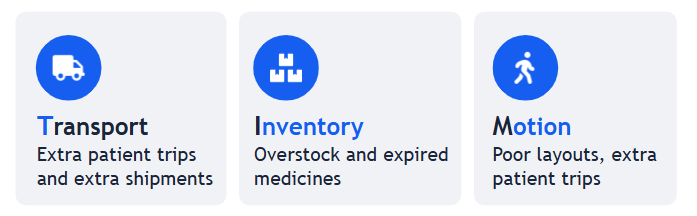
- Transport: Extra hospital shipments and journeys burn fuel.
- Inventory: Overstocked and expired medicines carry all the emissions of making them, without any patient benefit.
- Motion: Poor hospital layouts mean extra trips and energy for patients and staff.
- Waiting: Idle MRI/CT scanners and any electrical equipment, from lighting to computer terminals, left powered on.
- Overproduction: Prepared sterile surgical packs opened and not used; food waste, and tests that aren't needed.
- Over-processing: Using single-use plastics for routine non-sterile tasks, including gloves, and over-packaging minor dressings.
- Defects: Rework and repeat procedures double the footprint.
- Skills: Frontline nurses, porters, surgery staff, and pharmacists ideas left untapped: the people closest to the work see the waste first.

Start With The Data You Already Have
The worry Nocomed hears most often is "our data isn't good enough". Nocomed's answer: imperfect data is a starting point, not a barrier. Start with what you have and improve it over time.
- Gather procurement, finance, energy, waste and transport records.
- Clean and standardise them, because data from different sources comes in different formats.
- Visualise the hotspots by applying emission factors.
- Ask why. Once people can see the hotspots, they start asking "why do we do it this way?", which is exactly the question Lean teams are good at.
The Core Carbon Formula
The calculation itself is simple: activity data × emission factor = emissions (kg CO2e, kilogrammes of carbon dioxide equivalent). For energy, travel and waste, use published conversion factors, such as SEAI's factors for Irish electricity and fuels, which are updated every year.
{Activity Data} * {Emission Factor} = {Emissions (kg CO2e}
Spend-Based Estimates
Purchased goods, which make up most of a hospital's footprint, can be measured two ways. A spend-based estimate multiplies spend times a sector-average factor; it's quick, but it can't tell two suppliers of the same product apart.
Product-Level Estimates
A product-level estimate uses supplier data, product carbon footprints, environmental product declarations or life cycle assessment (LCA) databases such as ecoinvent. It's more work, but far more accurate, and it lets you compare products.
Imperfect data is a starting point, not a barrier: start spend-based, then improve with supplier data.
Most organisations start spend-based and improve with supplier data. The first round of data collection takes the longest. After that it becomes routine: annual, then quarterly, and eventually monthly. Software systems enable real-time data collection, live updates, automatically calculating carbon emission and slick visuals to aid understanding of key leverage points to reduce emissions.
Put People At The Heart Of It
The most successful sustainability projects work with the existing culture and bring teams along. Once people can actually see their data, they tend to become quite motivated by it. Visualisations are tremendously helpful to spot trends and identify leverage points.

- Use the teams you have. Lean and business excellence teams already know how to remove waste.
- Widen the room. Carbon sits in procurement and pharmacy as much as the facilities department, so bring those teams, clinicians, and expertise into the conversation.
- Build skills. Most staff were never trained in sustainability, and that's OK.
- Work with the culture. Fit the plan to your organisation's size, budget and people.
Training already exists. The HSE's Climate and Sustainability Learning Hub on HSE Land, a one-stop shop for all staff organised around six action areas. Five modules, each 30 minutes and with CPD accreditation, are already live, including Greening your theatre, Greening your emergency department and injury unit and Greening your lab. For improvement teams, they are an easy way to build skills before a green Lean project.
Running PDSA With A Carbon Lens
Improvement teams already know Plan-Do-Study-Act. The change is to treat carbon like any other measure you track, alongside cost, quality and safety.
- Plan: Pick a hotspot and measure its baseline carbon and cost.
- Do: Pilot the carbon change small, with the people who do the work.
- Study: Measure carbon, cost, quality, and staff and patient experience. Carbon should never come at the expense of care.
- Act: Scale what works, standardise it and share the results.
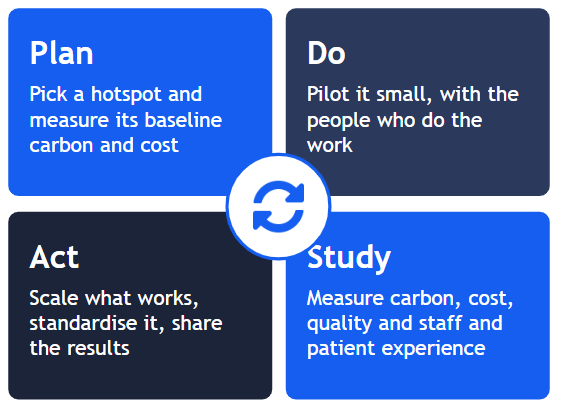
Before-and-after evidence is what proves a change works, and that's what keeps teams motivated to scale it.
In Practice: Real-World Healthcare Case Studies
Purchased Medicines and Medtech
With a Dublin hospital, Nocomed is running a Scope 3.1 pilot on everyday products including paracetamol, gloves and medical gases. Starting from the hospital's own purchasing records, Nocomed's software platform maps products to emissions, finds the hotspots and measures the carbon and cost saved by each change. No patient data is used.

Healthcare Product Take-back Schemes
Nocomed is working with healthcare partners to measure the carbon saved by taking back used products. Inhalers, for example, still contain gases or materials with an exceptionally high carbon impact, even when they go to landfill. Recovering them is a classic waste-reduction project with a measurable carbon result.

Where Improvement Teams Can Start Immediately
These well-trodden starting points all look a lot like classic Lean projects:
- Energy: Switch-off routines, heating and ventilation scheduling, LED lighting and green energy.
- Anaesthetic gases: Low-flow techniques and lower-impact agent choices, such as reducing or removing desflurane and nitrous oxide.
- Product choice: Lower-carbon options where clinically appropriate, and take-back schemes for used products.
- Single-use: Review where safe reusables could replace disposables.
- Waste: Right item, right bin. Better segregation is both cheaper and lower carbon.
- Stock: Cut expiry and consolidate deliveries with suppliers.
Clinical decisions stay clinical. Carbon information adds to a decision; it never overrides patient safety or quality.
Two Carbon Oars: Reduction and Resilience
Every product we don't waste is carbon and cost saved.
Nocomed describes this as rowing with two oars: carbon reduction, by measuring emissions and tackling the hotspots with clinical, procurement, pharmacy and facilities teams as well as suppliers, and climate resilience, by preparing hospitals and supply chains for heatwaves and flooding.
The direction of progress is simple; measure, reduce, report, then buy and use better. Healthcare sustainability data will sit alongside price and quality when choosing products and suppliers. The goal is the right product, in the right quantity, used to its full value. Every product we don't waste is carbon and cost saved.
Three Practical Steps To Try Next Week
Here are three practical steps for improvement teams, none of which needs software:
- Find one data source you already have, such as energy bills, waste invoices or procurement spend.
- Add a carbon question to your next improvement project: "What's the carbon impact of this waste?"
- Bring one new person into the room: someone from procurement, pharmacy or facilities.
Lean already gives us the tools to remove waste. Adding a green lens means we protect our patients, our staff and our planet at the same time.
You may even opt to manage reporting of supply chain emissions, identify energy and cost savings, and improve your healthcare sustainability credentials with Nocomed's sustainability platform.
******************************************************
Frequently Asked Questions (FAQ) About Lean for Green Healthcare
In healthcare, what does Scope 3 emissions?
Scope 3 encompasses all indirect emissions across the value chain, excluding direct facilities emissions (Scope 1) and purchased electricity (Scope 2). It includes pharmaceuticals, medical devices, consumables, waste handling, transport, and staff travel. Scope 3 represents roughly 71% of healthcare's total greenhouse gas footprint (Health Care Without Harm and Arup, 2019).
How Do Hospitals Calculate Carbon From Procurement Records?
Emissions are calculated using the formula:
{Activity Data} * {Emission Factor} = {Emissions (kg CO2e)}
Hospitals can start with spend-based estimates using financial spend records and sector averages, then progress to product-level data using supplier metrics, Environmental Product Declarations (EPDs), or Life Cycle Assessment (LCA) databases like ecoinvent.
Can Lean PDSA Cycles Include Carbon Metrics Without Affecting Patient Care?
Yes. Carbon is added as a fourth core metric alongside cost, quality, and patient safety in standard Plan-Do-Study-Act (PDSA) cycles. Clinical safety and care quality always remain primary; carbon data acts as an additional decision metric to eliminate unnecessary operational cost and carbon waste.
How Does Nocomed Analyze Hospital Scope 3 Emissions Without Accessing Patient Data?
Nocomed's solution maps scope 3.1 emissions directly from institutional purchasing and procurement records. In a Dublin hospital pilot everyday items, like paracetamol, gloves, and medical gases, were converted into emission metrics using procurement spend and quantity data to find carbon hotspots. No patient health record information is required.
Data Source Summary - 'Lean with Green Lens', at UCD Mater 13th National Annual Healthcare Symposium
- Health Care Without Harm and Arup (2019), Health Care's Climate Footprint
- MedTech Europe and BCG (2025), Decarbonising Healthcare: How a Competitive Medical Technology Industry Can Contribute
- Janoš et al., ISGlobal (2025), Heat-related mortality in Europe during 2024, Nature Medicine
- Guy's and St Thomas' NHS Foundation Trust (2023), Review of the IT critical incident
- Sancho et al. (2026), Critical care during natural disasters: ICU insights from Valencia's October 2024 floods, Medicina Intensiva
- European Environment Agency (2026), premature deaths attributable to fine particle air pollution
- HSE Climate and Sustainability Learning Hub, HSE Land
- About Nocomed